Someone signs up for your product.
Nice.
You got the notification, checked their email domain, and perhaps opened LinkedIn to investigate who this beautiful new person might be.
Then they disappear.
The signup was real. The value was not, at least not yet.
This is the gap early-stage builders often miss. We work hard to bring people to the landing page and celebrate when they create an account. But an account is only permission to begin.
The user still needs to reach the reason they came.
That first experience of real value is the activation moment.
Signup means interest. Activation means understanding.
A signup tells you the promise was interesting enough to try.
Activation tells you the product began delivering on that promise.
For an invoicing tool, activation may be sending the first real invoice.
For a meeting assistant, it may be receiving the first useful summary after a call.
For a design tool, it may be exporting the first design they are willing to share.
For a team product, it may not happen until a second person joins and does something useful.
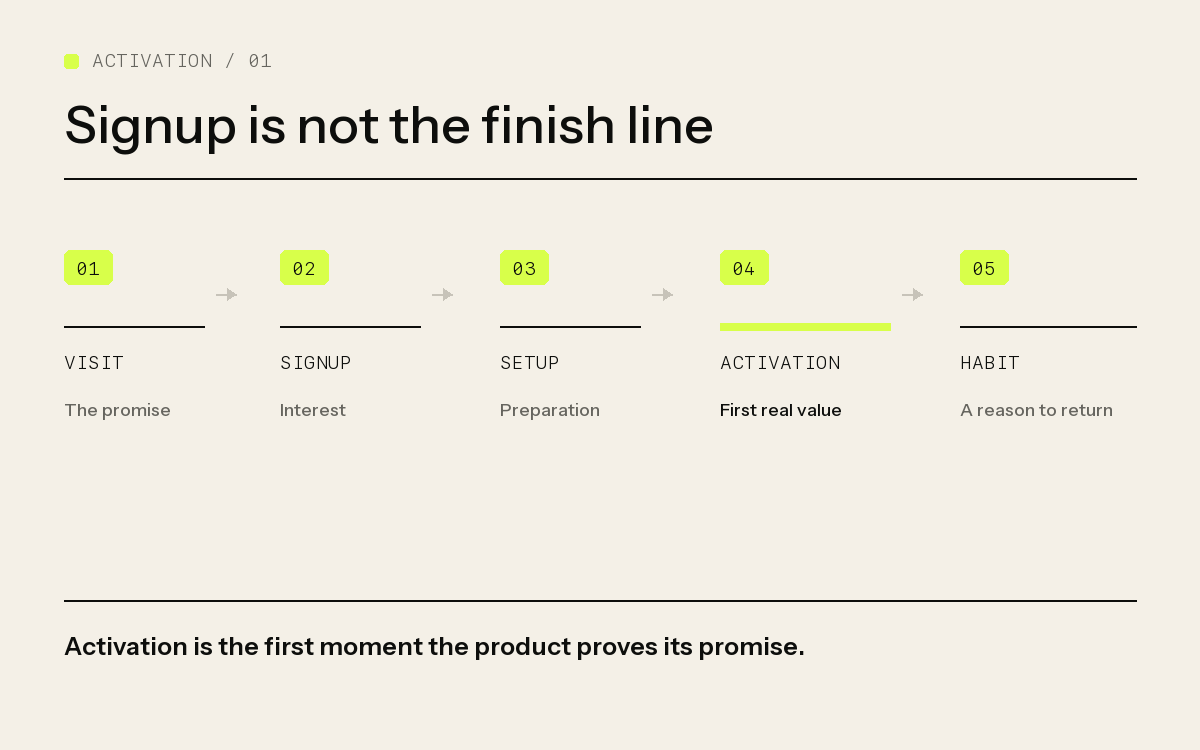
Notice that activation is not necessarily completing onboarding.
Watching a welcome video, checking three setup boxes, or connecting an account may help the user reach value. None of those steps are automatically valuable by themselves.
Do not confuse finishing your instructions with achieving their goal.
Find the action that changes the user’s mind
The activation moment often sounds like:
“Oh, I get it now.”
Before that moment, the product is still a claim. Afterward, the user has evidence.
Your job is to identify what happened between those two states.
Start with users who stayed.
Ask them:
- What did you first come here to do?
- When did the product start feeling useful?
- What happened in your first session?
- What result made you want to return?
- Was there anything you did not understand until you saw it work?
Then compare their early behavior with people who disappeared.
Did retained users create a project? Import real data? Invite someone? Finish one workflow? See a result within ten minutes instead of two days?
You are looking for the earliest meaningful action that appears more often among people who return.
Not the action that is easiest to track. The action that represents value.
Activation should match the promise
Look at the message on your landing page.
What did you tell people would become better?
If the headline promises faster client approval, activation is not “created a workspace.” It is closer to “received and resolved the first client comment.”
If the headline promises clarity on marketing performance, activation is not “connected Google Analytics.” It is “found an answer they could not see before.”
If your activation event has no relationship with your promise, you may be optimizing users to complete setup instead of experience value.
That produces a beautifully efficient journey to nowhere.
Measure both success and speed
Two simple questions matter:
- What percentage of new users reach activation?
- How long does it take them to get there?
The second one is easy to overlook.
Imagine two products with the same activation rate. In one, users reach value in five minutes. In the other, they need three days, two integrations, and a reply from support.
Those are not equally healthy experiences.
Every extra step gives confusion, distraction, and ordinary life another chance to win.
Track time to value from the user’s point of view. The clock starts when they arrive with a problem, not when your onboarding software begins counting.
Remove the distance, not only the friction
Once you define the activation moment, map every step before it.
Then ask an unpleasant question about each one:
Does this need to exist?
Founders often improve onboarding by making each step slightly prettier or easier. Sometimes the better move is to remove the step completely.
You can:
- prefill an example instead of presenting an empty screen;
- let users try a result before creating an account;
- use a template based on their situation;
- postpone settings that do not affect first value;
- import existing work instead of asking them to recreate it;
- manually set up the first few users.
Yes, manually.
At an early stage, doing the work for ten users can teach you more than building an onboarding system based on guesses. Watch where they hesitate, what you need to explain, and which step creates the first visible relief.
Automate after you understand the journey.
What if you barely have users?
You do not need a statistically proven activation metric before thinking about activation.
Write a hypothesis:
We believe a new user first experiences value when they [specific action and result].
Then use it to observe onboarding sessions.
If you believe activation happens when a founder sees their first useful channel recommendation, watch what happens around that moment. Do they ask better questions? Do they try the recommendation? Do they return? Do they share another product?
Your first definition will probably be wrong or incomplete.
Good. Now you have something specific to improve.
“Users are not engaging” is a fog.
“Only two of ten users reached their first useful recommendation, and both needed help choosing a target moment” is a product decision waiting to happen.
Do not celebrate at the door
A signup is not nothing. It means your message earned a small amount of trust.
But the work is not finished when someone enters.
Get them to the first result that makes the product feel real. Make that result easier to reach. Watch whether it gives them a reason to return.
Traffic tells you that people arrived.
Signup tells you that they were curious.
Activation tells you that they finally understood why your product matters.


